Crypto Payment Setup Guide for E-Commerce Success

Choosing how your customers pay can shape your entire business experience. For many E-commerce owners, the push to offer cryptocurrency payment systems is about more than convenience. It means attracting global shoppers, lowering transaction fees, and solving cross-border payment headaches. Yet, meeting compliance standards and managing risks is just as important. This guide helps you lay a strong foundation for successful crypto integration in your online store.
Table of Contents
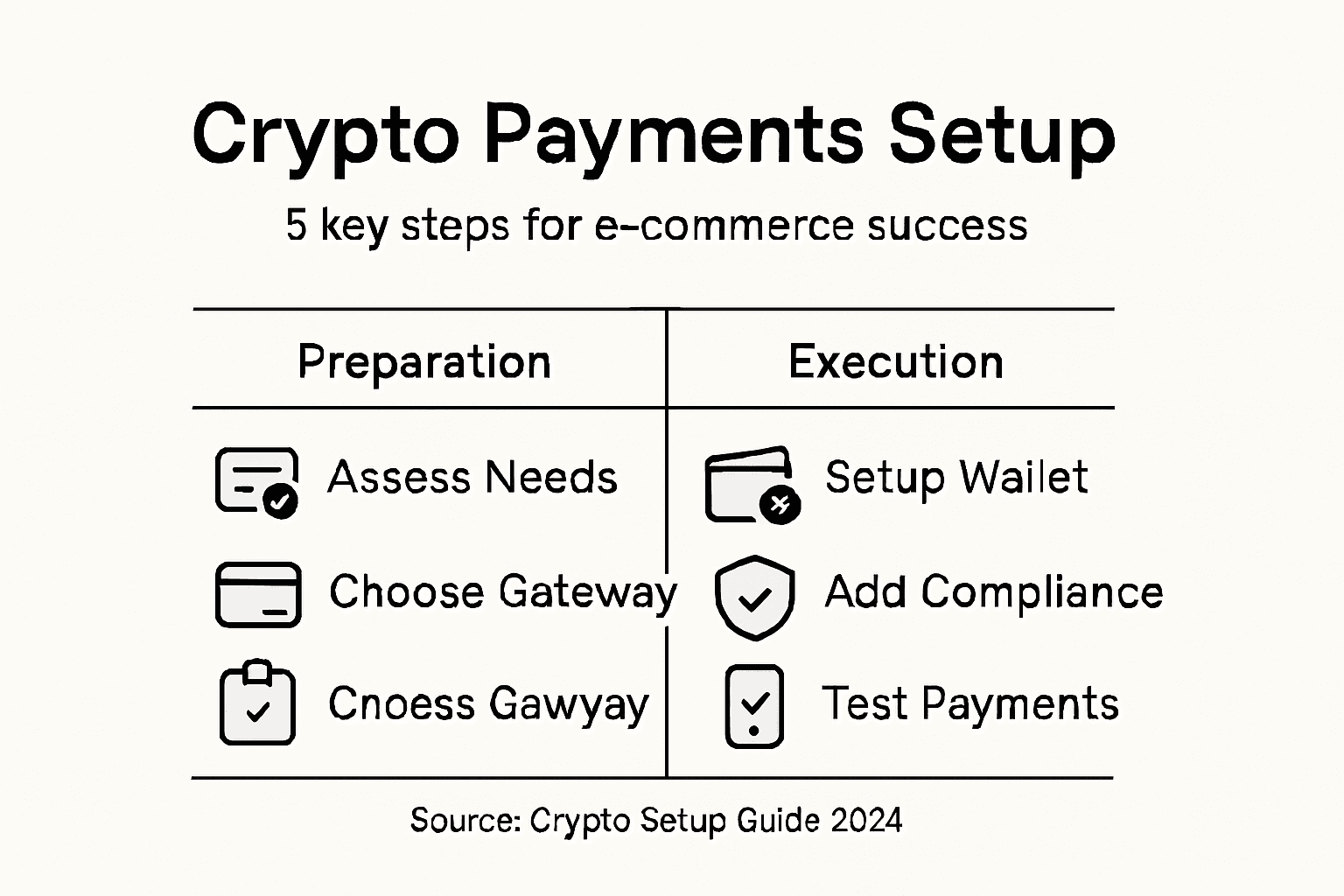
- Step 1: Assess Business Requirements For Crypto Payments
- Step 2: Select And Integrate A Crypto Payment Gateway
- Step 3: Configure Multi-Currency Wallet And Fiat Conversion
- Step 4: Enable Automated Compliance And Risk Checks
- Step 5: Test And Verify Payment Processing Functionality
Quick Summary
| Key Insight | Explanation |
|---|---|
| 1. Assess Business Requirements Thoroughly | Understand transaction volumes, geographic markets, and regulatory requirements to ensure a successful integration of crypto payments. |
| 2. Choose a Secure Payment Gateway | Select a payment gateway that offers security, multi-currency support, and compliance tools to enhance user experience and financial performance. |
| 3. Configure a Multi-Currency Wallet | Implement a wallet solution that supports various cryptocurrencies, automatic conversions, and robust security to effectively manage transactions. |
| 4. Implement Automated Compliance Checks | Use automated systems for KYC and AML to proactively manage risks and maintain adherence to regulatory standards. |
| 5. Conduct Comprehensive Testing | Test payment functionality under various scenarios to ensure a smooth, secure transaction process before going live. |
Step 1: Assess business requirements for crypto payments
Successfully integrating cryptocurrency payments into your e-commerce platform requires a comprehensive assessment of your business’s specific operational needs and risk profile. Understanding these requirements is crucial for a smooth and compliant implementation that protects your financial interests.
Start by evaluating your business’s transaction volumes, geographic markets, and regulatory landscape. This means analyzing which cryptocurrencies align with your customer base and understanding compliance requirements across different jurisdictions. The Financial Stability Board’s regulatory recommendations provide essential guidance on assessing the permissibility and operational risks associated with crypto payments.
Key considerations include transaction speed, conversion rates, integration complexity with existing payment systems, and potential tax implications. You will want to examine factors such as volatility risk, transaction fees, settlement times, and the technical infrastructure required to support crypto transactions. Additionally, assess your team’s technical capabilities and whether you need external expertise to manage cryptocurrency payment processes.
Pro tip: Conduct a pilot test with a limited cryptocurrency offering to understand real world implementation challenges before full platform integration.
Step 2: Select and integrate a crypto payment gateway
Selecting the right cryptocurrency payment gateway is a critical decision that can significantly impact your e-commerce platform’s financial performance and user experience. Your goal in this step is to identify a solution that provides secure, efficient, and compliant crypto transaction processing.

Begin by researching payment gateways that support multiple cryptocurrencies and offer robust integration frameworks for digital payments. Focus on platforms that provide advanced security features, competitive transaction fees, real time conversion rates, and seamless integration with your existing e-commerce infrastructure. Evaluate potential gateways based on their technical capabilities, such as instant settlement, multi currency support, and automated compliance checks.
Carefully review the technical documentation for each potential gateway to understand their API capabilities, supported cryptocurrencies, and integration complexity. Consider factors like transaction speed, blockchain network compatibility, and the gateway’s reputation in handling international transactions. Some gateways offer additional features like built in risk management tools, fraud detection systems, and regulatory compliance support that can streamline your payment processing workflow.
Pro tip: Request sandbox access and conduct thorough testing of the payment gateway’s integration before committing to a full implementation.
Here’s a summary of key focus areas for choosing and integrating a crypto payment gateway:
| Focus Area | Description | Business Impact |
|---|---|---|
| Security Features | Encryption, fraud prevention tools | Safeguards customer transactions |
| Multi-Currency Support | Handles various cryptocurrencies | Expands customer payment options |
| Compliance Tools | Automated KYC and AML processes | Reduces regulatory risk |
| Integration Complexity | API quality, setup speed | Influences launch timeline |
| Settlement Speed | Time to convert and settle | Affects cash flow management |
Step 3: Configure multi-currency wallet and fiat conversion
Configuring a multi-currency wallet is a crucial step in establishing a robust cryptocurrency payment infrastructure for your e-commerce platform. Your objective is to create a flexible financial system that can handle multiple digital currencies while enabling seamless conversions to traditional fiat currencies.
Start by selecting a wallet solution that supports comprehensive risk management frameworks and provides real-time conversion capabilities. Prioritize wallets that offer advanced features like automatic currency conversion, built-in compliance checks, and integration with major blockchain networks. Ensure the wallet supports major cryptocurrencies such as Bitcoin, Ethereum, and stablecoins, along with providing competitive exchange rates and minimal transaction fees.
Carefully configure your wallet’s security settings, including two factor authentication, IP whitelisting, and transaction limits. Implement robust verification processes for incoming and outgoing transactions to protect against potential fraud. Consider integrating additional risk mitigation tools that can help manage the inherent volatility of cryptocurrency markets, such as instant conversion mechanisms that automatically transfer received crypto payments into stable fiat currencies to minimize exposure to price fluctuations.
Pro tip: Regularly monitor and adjust your wallet’s conversion settings to optimize for the most favorable exchange rates and minimize transaction costs.
Compare main wallet configuration priorities at a glance:
| Wallet Feature | Importance | Result for Business |
|---|---|---|
| Real-Time Conversion | High | Minimizes currency risk |
| Robust Security Settings | Essential | Prevents unauthorized access |
| Multi-Asset Support | High | Enables more payment options |
| Risk Mitigation Tools | Important | Stabilizes revenue against volatility |
Step 4: Enable automated compliance and risk checks
Implementing automated compliance and risk checks is essential for protecting your e-commerce platform from potential financial and legal vulnerabilities associated with cryptocurrency transactions. Your primary objective is to create a robust system that proactively monitors and mitigates potential risks while maintaining regulatory compliance.
Begin by integrating comprehensive automated reporting mechanisms into your crypto payment infrastructure. Configure your system to automatically perform Know Your Customer (KYC) verifications, anti money laundering (AML) screenings, and transaction monitoring protocols. These automated checks should cross reference user data against global watchlists, validate transaction origins, and flag suspicious activities in real time.
Develop a multi layered risk management strategy that includes sophisticated algorithmic screening for unusual transaction patterns, geographic risk assessments, and automated compliance reporting. Implement machine learning algorithms that can adapt to evolving regulatory requirements and detect potential fraudulent activities across different cryptocurrency networks. Ensure your compliance system can generate comprehensive audit trails and generate instant alerts for transactions that require manual review or potentially violate international financial regulations.
Pro tip: Periodically update your automated compliance rules to stay ahead of emerging regulatory requirements and evolving financial crime tactics.
Step 5: Test and verify payment processing functionality
Validating your cryptocurrency payment processing system is a critical step in ensuring smooth and secure transactions for your e-commerce platform. Your goal is to create a comprehensive testing strategy that thoroughly examines every aspect of your payment workflow before going live.
Begin by implementing comprehensive transaction verification protocols that simulate real world payment scenarios. Set up a staged testing environment where you can conduct end to end transaction tests across multiple cryptocurrencies, payment amounts, and user profiles. This should include testing successful transactions, partial payments, transaction reversals, and potential edge cases such as network congestion or sudden price fluctuations.
Develop a structured testing approach that covers multiple dimensions of payment functionality. This includes verifying API integrations, confirming accurate real time currency conversions, testing security protocols, and ensuring seamless communication between your payment gateway, wallet, and e-commerce platform. Pay special attention to transaction speed, fee calculations, compliance checks, and the overall user experience. Conduct both automated and manual tests to identify potential vulnerabilities or performance bottlenecks that could impact your payment processing system.
Pro tip: Create a comprehensive test script that includes scenarios with various cryptocurrency types, transaction sizes, and potential network conditions to ensure robust system performance.
Streamline Your Crypto Payment Setup with Bankto.io
Integrating cryptocurrency payments into your e-commerce platform can feel overwhelming when facing challenges like selecting the right crypto payment gateway, managing multi-currency wallets, and ensuring automated compliance and risk checks. This guide highlights core pain points such as volatility risk, complex integration, and regulatory compliance that can slow down your path to seamless crypto acceptance. At Bankto.io, we understand these hurdles and provide tailored fintech solutions that combine secure multi-cryptocurrency wallets, instant fiat conversions, and risk assessment features to simplify your payment infrastructure.
Take control of your crypto transactions now by exploring our comprehensive platform designed to lower transaction costs and accelerate borderless operations. Whether you need support with secure wallets or automated compliance, Bankto.io offers all the tools needed for a successful crypto payment system.
Ready to unlock the full potential of crypto payments on your online store? Visit Bankto.io to discover our enterprise solutions and start your seamless integration journey today. Learn more about our crypto gateways and how instant fiat conversions can protect your revenues from market volatility.
Frequently Asked Questions
How do I assess my business requirements for cryptocurrency payments?
To assess your business requirements for cryptocurrency payments, evaluate transaction volumes, geographic markets, and regulatory considerations. Analyze which cryptocurrencies align with your customer base and review compliance requirements.
What should I look for when selecting a crypto payment gateway?
When selecting a crypto payment gateway, prioritize security features, multi-currency support, and compliance tools. Test the gateway’s integration capabilities by requesting sandbox access to ensure it meets your operational needs.
How do I configure a multi-currency wallet and perform fiat conversions?
To configure a multi-currency wallet, choose one that supports various cryptocurrencies and offers real-time conversion. Set up security measures like two-factor authentication and regularly monitor conversion settings to optimize exchange rates.
What automated compliance checks should I implement for crypto transactions?
Implement automated compliance checks that cover Know Your Customer (KYC) verifications and anti-money laundering (AML) screenings. Configure your system to flag suspicious activities in real-time to maintain regulatory compliance.
How can I test my crypto payment processing functionality effectively?
To test your crypto payment processing functionality, create a staged testing environment to simulate real-world payment scenarios. Develop a comprehensive test script that covers various cryptocurrencies, transaction amounts, and edge cases, ensuring robust system performance.